
AI-Driven 3D Printing in 2025: The Next Leap in Speed, Precision, and Automation
AI is transforming 3D printing in 2025, accelerating workflows, enabling advanced materials, and redefining manufacturing—but at what cost to human creativity?
The Rise of AI in Additive Manufacturing
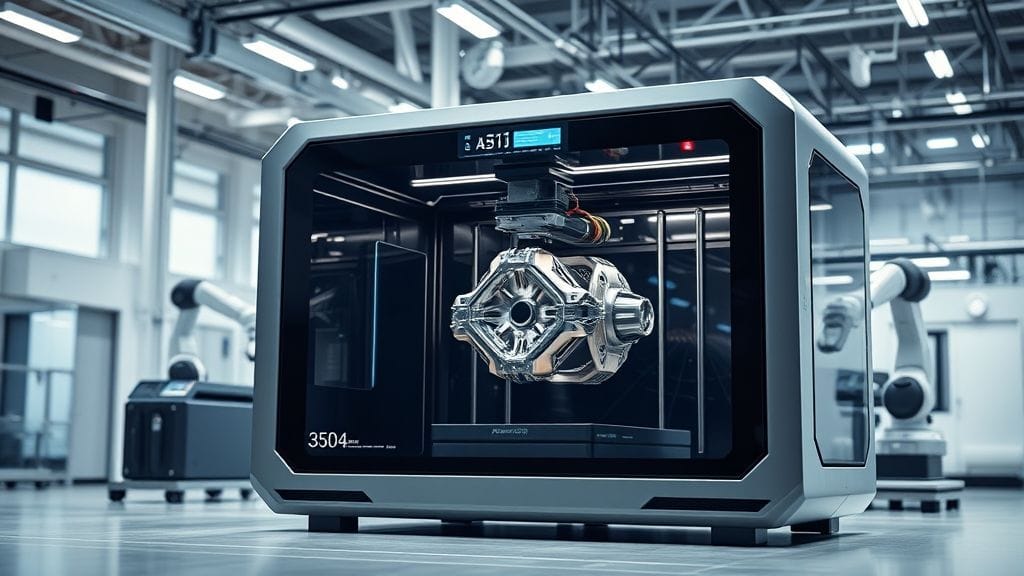
In 2025, artificial intelligence is no longer an experiment—it’s the engine driving a seismic shift in 3D printing. From initial design to final production, AI-powered tools are compressing timelines, predicting failures, and optimizing material usage with surgical precision. This automation of the creative and logistical workflow is not just an incremental gain; it is redefining what’s possible in prototyping, custom manufacturing, and mass customization. Enterprises now deploy AI to slash material waste, reduce misprints, and achieve unprecedented consistency, making additive manufacturing faster, cheaper, and more accessible than ever before[2].
Streamlined Workflows, Accelerated Outcomes
Industries under relentless pressure to innovate are turning to AI-driven 3D printing to shrink development cycles and compress time-to-market. High-speed prototyping, enabled by technologies like SLS and SLA, now delivers parts overnight, allowing teams to iterate rapidly and validate functional prototypes with real-world conditions in near real-time[1]. Automated quoting, material selection, and process optimization—once manual, error-prone tasks—are now handled with machine precision, freeing engineers to focus on design and innovation rather than troubleshooting[2].
Advanced Materials and Multi-Material Breakthroughs
AI’s influence extends to material innovation, where 2025 sees a renaissance in polymers, composites, and hybrid materials. Carbon-fiber composites, high-performance polymers, and even multi-material prints are now feasible, enabling parts with unprecedented combinations of strength, flexibility, and functionality[2]. This material expansion is unlocking new applications in aerospace, healthcare, and consumer electronics—industries where customization and performance are non-negotiable.
The Human Counterpoint: Automation Versus Creativity
Yet, as AI and automation reshape the 3D printing landscape, a countercurrent emerges. The risk is a paradox of efficiency: as machines handle more of the creative and logistical burden, the space for human intuition, improvisation, and serendipitous discovery may narrow. While AI excels at optimization, the most groundbreaking innovations often spring from unpredictable human insight. The challenge—and opportunity—for 2025 is to harness AI’s power without extinguishing the creative spark that has always driven additive manufacturing forward.