
Hybrid Manufacturing Emerges as 2025's Defining 3D Printing Trend: The Strategic Convergence of Additive and Traditional Methods
Hybrid manufacturing—merging additive and traditional processes—emerges as 2025's defining trend, fundamentally reshaping industrial production.
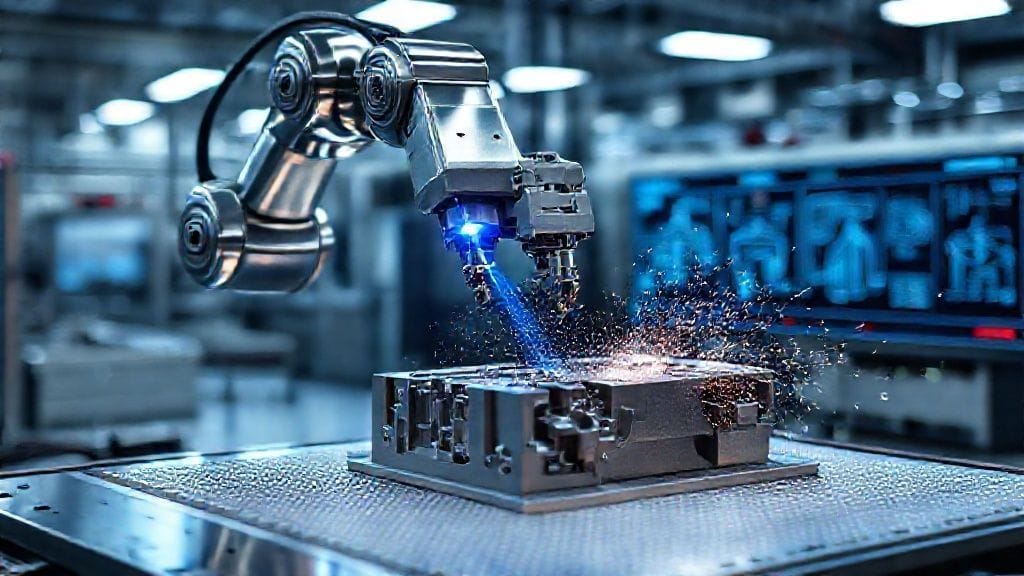
The Manufacturing Inflection Point
The manufacturing landscape is experiencing a seismic shift in 2025. The future no longer belongs to companies choosing between additive manufacturing and traditional processes—it belongs to those orchestrating their seamless integration. Hybrid manufacturing represents the convergence of additive manufacturing (AM) with CNC machining and injection molding, enabling organizations to leverage the precise strengths of both technologies simultaneously. This strategic merger isn't theoretical; it's actively reshaping production capabilities across automotive, aerospace, and industrial sectors. The urgency is unmistakable: manufacturers who fail to adopt hybrid approaches risk operational obsolescence in an increasingly competitive landscape.
Why Hybrid Manufacturing Commands Center Stage
The market data speaks with crystalline clarity. In 2025, the global 3D printing market reached USD 29.29 billion, with prototyping dominating 55% of total revenues—yet this acceleration masks a deeper transformation. Hybrid manufacturing unlocks capabilities neither technology can achieve independently. Additive manufacturing excels at complex geometries and rapid iteration; traditional machining delivers surface finish precision and structural integrity. When deployed strategically, this combination compresses development cycles, expands design possibilities, and dramatically improves productivity. Companies are no longer asking whether to invest in additive or traditional manufacturing—they're architecting integrated workflows that exploit the optimal process for each phase of production, fundamentally accelerating time-to-market and reducing operational friction.
The Operational Reality: Where Hybrid Systems Deliver Impact
Real-world deployment reveals the transformative power of hybrid approaches. In automotive manufacturing, companies are using additive processes to rapidly prototype complex assemblies, then seamlessly transitioning to precision machining for final dimensional tolerance work. The aerospace sector leverages this dual capability to manufacture lightweight structural components with internal channels and cooling passages—geometries impossible with traditional methods alone—followed by final machining to exacting specifications. This orchestrated workflow reduces material waste by up to 60%, compresses prototype-to-production timelines from months to weeks, and enables manufacturers to maintain competitive advantage through design innovation. The productivity gains are measured and material: faster iteration cycles, reduced tooling requirements, and enhanced design freedom that competitors relying on single-process workflows simply cannot match.
Integration with Digital Manufacturing Ecosystems
Hybrid manufacturing gains exponential power when integrated with digital manufacturing ecosystems. Cloud-based platforms enable real-time collaboration across global facilities, while IoT sensors embedded in both additive and traditional equipment provide live performance data. This digital infrastructure creates unprecedented visibility into production workflows, enabling predictive maintenance that eliminates costly downtime and facilitating on-demand part delivery across distributed operations. Automotive companies are actively consolidating production across international facilities through centralized digital platforms—a capability that demands seamless coordination between additive and traditional processes. The convergence of hybrid manufacturing with digital ecosystems represents the operational foundation of Industry 4.0, delivering measurable advantages in speed, quality, and responsiveness.
A Measured Perspective: The Implementation Challenge
Yet the promise of hybrid manufacturing warrants measured assessment. Implementation complexity remains significant; companies require substantial capital investment in equipment, software integration expertise, and workforce retraining. Organizations with established, optimized traditional manufacturing workflows may find that incremental additive capabilities generate marginal returns insufficient to justify transition costs. For industries with stable product designs and established supply chains, hybrid approaches may represent unnecessary operational overhead rather than strategic advantage. The competitive imperative for hybrid manufacturing is most compelling for sectors characterized by rapid innovation cycles, design complexity, and time-to-market pressure—not uniformly across all manufacturing verticals. Strategic leaders must conduct rigorous cost-benefit analysis before committing organizational resources to hybrid transformation.